Hideaway Golf Club: Luxury Living Against the Mountains of La Quinta
Some private golf communities are defined primarily by their courses. Others by their homes or club amenities. Hideaway Golf Club succeeds because those elements were conceived as parts of the same environment — a low-density private community where two distinctly different golf experiences, architecture, landscape and an active social life come together against one of La Quinta’s most dramatic mountain settings.
Spread across nearly 600 acres, Hideaway contains just 434 residences, creating a sense of space and privacy that remains one of the community’s defining characteristics. Originally developed by Discovery Land Company and member-owned since 2021, Hideaway has continued to evolve while preserving the intimate character at the center of its appeal.
Two Courses, Two Distinct Personalities
Golf at Hideaway is built around two 18-hole, par-72 courses designed by Pete Dye and Clive Clark. Rather than offering two variations of the same experience, the courses have distinctly different personalities.
The Pete Dye Course, completed in 2001, reflects the strategic character associated with its designer. Rolling fairways framed by native grasses give way to broad stretches of sand, streams and ponds, with water and bunkering repeatedly influencing decisions from tee to green. The course underwent a significant restoration led by golf architect Tim Liddy in 2024, including restored greens and upgraded bunkering.
The Clive Clark Course presents a different visual and strategic experience. Clark brought influences from his British golf background to the Southern California desert, combining gently rolling fairways and broad greens with waterfalls, water features, palms and vivid desert wildflowers. The result is a course that can be visually inviting while still rewarding thoughtful shotmaking.
Membership is intentionally limited to 450 golf members — 225 per 18-hole course — helping preserve the uncrowded golf environment and intimate club experience that Hideaway was designed to provide.
Luxury Without a Single Architectural Formula
Hideaway’s residential character is equally important to its identity. Its 434 properties range from Villas and Bungalows to individually designed custom residences and homesites, allowing the community to offer architectural variety without losing an overall sense of place. Spanish and Mediterranean influences appear throughout the community alongside more contemporary interpretations of desert architecture.
The setting does much of the remaining work. Homes are positioned around fairways, lakes and landscaped open space, with many oriented toward the Santa Rosa Mountains. Private courtyards, pools and expansive outdoor living areas take advantage of a climate in which the relationship between the house and its surroundings is fundamental to desert living.
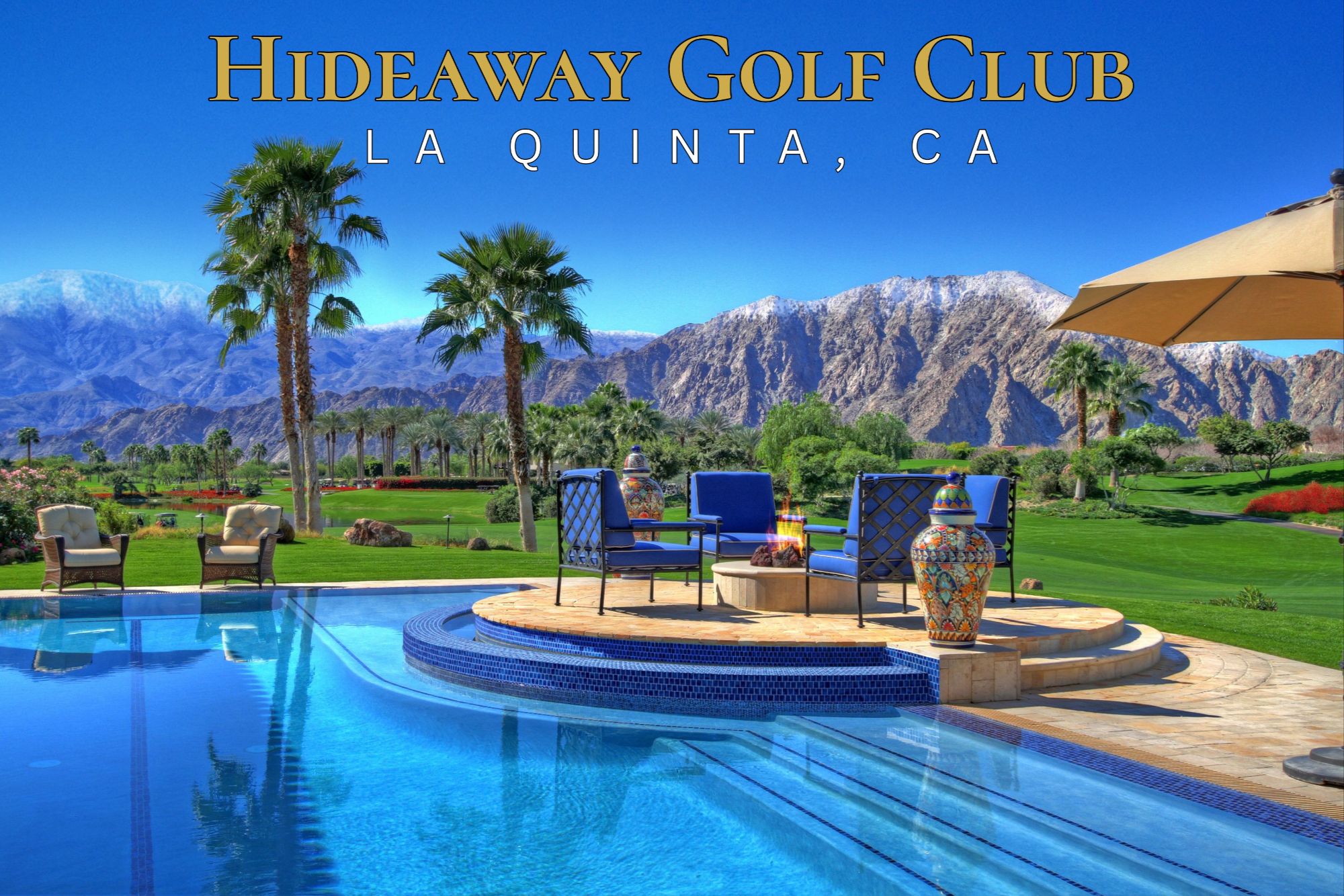
I experienced that residential side of Hideaway firsthand in 2012 when I represented buyers in the purchase of a residence here for just under $6 million. The home photographed for this article was that property. Beyond its architecture and finishes, what stayed with me was the way the residence, pool, golf course and mountains became parts of a single view. That integration between the homes and their surroundings remains one of Hideaway’s greatest strengths.
The Club at the Center
At the heart of Hideaway is its 80,000-square-foot Spanish Colonial clubhouse, conceived not simply as a golf facility but as the social center of the community. Dining, wellness, recreation and an active calendar of events give the club an identity that extends well beyond the two golf courses.
That experience has recently undergone a substantial reinvestment. Hideaway completed a nearly $50 million renovation in January 2026 encompassing both golf courses, expanded clubhouse facilities, a new spa and fitness center, renovated dining areas and locker rooms, expanded racquet facilities, enhanced practice areas and The Key, a new poolside restaurant and bar overlooking the Clive Clark Course.
Members also have access to tennis, pickleball, bocce, a resort-style pool, full-service spa and fitness facilities, while dining ranges from the main clubhouse and bar to private dining in the club’s 3,000-bottle wine cellar.
A Community Designed Around Connection
Luxury private communities can sometimes become collections of impressive houses whose owners happen to share an address. Hideaway was designed around a different idea.
Its limited membership, family privileges, year-round operation and emphasis on social programming encourage members to use the club rather than simply belong to it. Golf remains central, but dinners, fitness, racquet sports, poolside gatherings and community events create opportunities for relationships to develop away from the fairways as well. Hideaway describes itself today as a social-oriented, family-friendly member-owned club, and its membership structure and amenities reflect that priority.
The transition to member ownership in June 2021 added another dimension to that identity. What began as a Discovery Land Company development is now a club whose future is ultimately guided by its membership.
The Hideaway Difference
Hideaway Golf Club occupies an interesting place among La Quinta’s private communities. It has the pedigree of Pete Dye and Clive Clark, substantial custom residences, an expansive clubhouse and the amenities expected at this level of the market. Yet those individual elements are not what make the community distinctive.
It is the way they fit together.
With only 434 residences across nearly 600 acres, two contrasting golf courses, a membership intentionally kept small and the Santa Rosa Mountains rising beyond its fairways and homes, Hideaway offers luxury without requiring scale to make its statement. Its character comes instead from privacy, setting, architecture and a club environment built around participation.
More than two decades after its first golf course opened, and following one of the most substantial reinvestments in the club’s history, Hideaway continues to evolve without abandoning the qualities that established its identity in the first place.
That, to me, is the Hideaway difference.
For a broader look at the communities, lifestyles and real estate markets that define Greater Palm Springs, explore my overview of the desert region.
Categories
Recent Posts